

In today’s digital world, cloud storage is no longer a luxury but a necessity. Whether you’re an entrepreneur, developer, or enterprise, storing and managing data in the cloud can significantly enhance your business’s efficiency. But with top cloud storage providers like Amazon Web Services (AWS), Google Cloud Platform (GCP), and Microsoft Azure leading the way, choosing the right one can be a bit daunting. Let’s dive in and compare these three giants in the cloud storage space.
1. What is Cloud Storage?
Cloud storage allows you to store data remotely on the internet instead of on local servers or hard drives. It provides benefits such as scalability, redundancy, and global access. Imagine no longer having to worry about running out of storage space or keeping your servers secure—cloud storage takes care of that for you.
2. Overview of the Top Cloud Storage Providers
Let’s take a closer look at the top three providers and what they offer:
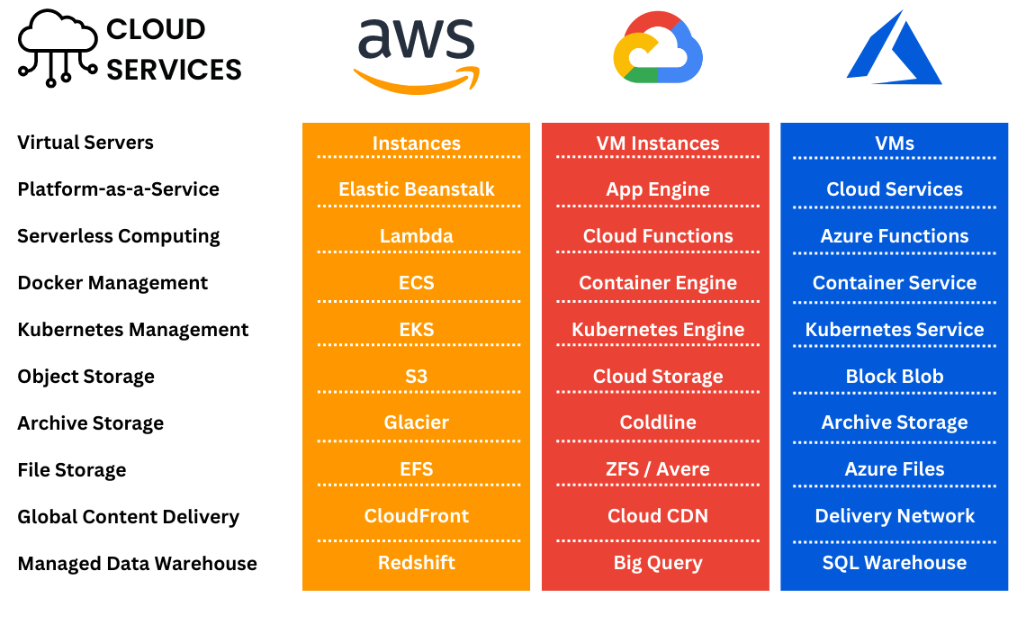
- Amazon Web Services (AWS) S3
AWS is a market leader in cloud storage, and its S3 (Simple Storage Service) is renowned for its high durability and availability. With features like versioning, lifecycle management, and cross-region replication, AWS S3 is a top choice for businesses of all sizes. It integrates seamlessly with other AWS services like Lambda and EC2, making it ideal for developers and data-driven companies. - Google Cloud Storage (GCS)
Google Cloud Storage stands out with its simplicity and tiered storage options. It offers Nearline and Coldline tiers for infrequently accessed data and Standard for everyday use, ensuring you pay only for what you need. If you’re already using services like BigQuery or Google Kubernetes Engine, GCS provides smooth integration, making it easier to manage data and analytics. - Microsoft Azure Blob Storage
Azure Blob Storage is known for its flexibility, with storage tiers such as Hot, Cool, and Archive for different data access needs. It supports large-scale workloads like backup and disaster recovery while providing seamless integration with other Azure services, such as Machine Learning and Power BI. If you’re a Microsoft shop, Azure might be the perfect fit.
3. Key Differences: AWS vs. Google Cloud vs. Azure
So, how do they stack up against each other? Let’s break down the main differences:
- Pricing Comparisons When it comes to pricing, all three providers offer pay-as-you-go models, but their rates and free-tier options vary. For instance, AWS charges based on data transfer and requests, while Google Cloud and Azure offer flat-rate storage costs but differ in retrieval fees. Make sure to check out the AWS S3 pricing, Google Cloud pricing, and Azure Blob Storage pricing for a detailed breakdown.
- Performance and Speed
AWS S3 tends to outperform others in terms of network infrastructure, thanks to its global network of edge locations. However, Google Cloud’s multi-regional storage offers competitive speeds, especially for users already leveraging Google’s backbone. Azure Blob Storage provides decent performance, but some users report slightly higher latency in non-Microsoft workloads. - Data Security and Compliance
All three providers are compliant with major industry standards like ISO/IEC 27001, HIPAA, and GDPR. However, AWS and Azure offer more robust built-in compliance features, whereas Google Cloud relies more on user-configured settings. - Ease of Use and Integrations
If you’re already using services like G Suite or Microsoft Office, it may be easier to integrate with Google Cloud or Azure respectively. AWS, on the other hand, shines with its extensive ecosystem and services, making it suitable for complex, multi-layered applications.
4. Use Cases for Each Cloud Storage Provider
Depending on your needs, one provider may be a better fit than the others:
- AWS S3 is perfect for large enterprises, developers, and businesses needing scalable storage for data-heavy applications, such as machine learning and big data analytics.
- Google Cloud Storage works well for businesses that require data analytics, machine learning workflows, or those already using Google’s productivity tools.
- Azure Blob Storage is ideal for organizations heavily invested in Microsoft technologies, offering excellent support for backup, disaster recovery, and enterprise workflows.
5. Pros and Cons of Each Provider
Here’s a quick rundown of what each one excels at and where they might fall short:
- AWS S3 Pros: Extensive features, scalability, wide range of integrations.
Cons: Can get expensive with heavy data transfer and request fees. - Google Cloud Storage Pros: Cost-effective tiered storage, smooth integration with Google products.
Cons: Fewer compliance features compared to AWS. - Azure Blob Storage Pros: Best for Microsoft ecosystem, strong security features.
Cons: Somewhat higher latency in non-Microsoft-related tasks.
6. How to Choose the Right Cloud Storage Solution for Your Needs
Choosing the right solution boils down to your specific requirements. Consider factors like budget, integration needs, performance requirements, and data access patterns. You might even find that a hybrid cloud approach—using multiple cloud services—offers the best balance of cost and functionality.
7. Conclusion
In summary, AWS, Google Cloud, and Azure each offer robust cloud storage options with unique strengths. While AWS S3 is often seen as the industry leader in features and integrations, Google Cloud Storage is great for businesses looking for cost-effective storage with excellent data analytics capabilities. Azure Blob Storage shines in Microsoft-centric environments, making it an excellent choice for organizations leveraging the Microsoft ecosystem.
Explore your options, try out the free tiers, and see which provider best meets your cloud storage needs.
